Concrete Color Consistency
A Production Guide to Dry Cast Concrete Color Consistency
We often get asked the question by customers. Why are we experiencing color matching issues, and how do we stop this from happening again?
Concrete color is complex and influenced by many variables. When color concerns arise, it is helpful to have an understanding of concrete technology basics to determine why this happened and implement effective corrective actions.
Before diving into raw materials, production, and other concrete technology variables, let us review some basic principles of color perception.
Introduction to Concrete Color
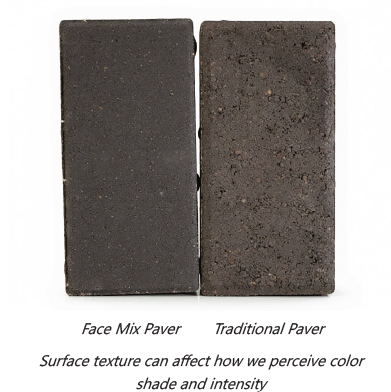
Color and texture are often thought of as separate characteristics. Color refers to shades like red or black, while texture describes surface qualities like rough or smooth. However, texture significantly impacts color perception by manipulating light reflection, scattering, and shadow, making colors appear lighter, darker, or more saturated depending on surface roughness. Rough textures create shadows that deepen and mute colors, while smooth, glossy surfaces reflect more light, making colors appear more vibrant.
The effect of texture can be observed in face mix pavers, which generally have a smoother, tighter surface texture than traditional pavers. The smoother surface texture can make colors appear brighter and more intense. Variances in aggregate fineness modulus (FM), machine vibration, and compaction times can also affect surface texture and appearance.
Other factors, such as efflorescence, can also impact color. Colors may appear to be faded or hazy due to efflorescence deposits on the surface. When the efflorescence is removed, unit color vibrancy is restored.
We should also note that while production crews should aim for the highest level of color consistency possible, manufactured concrete products are made from natural raw materials that can and do vary in color shade and texture. Color consistency perfection is not a realistic goal. Sales and marketing materials should educate customers and set expectations accordingly.
Pigments
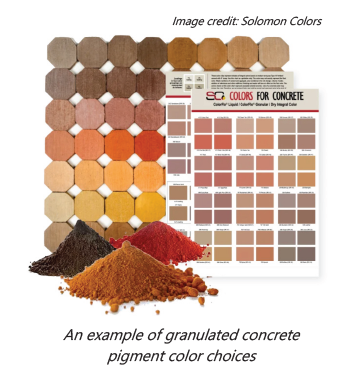
Architectural concrete colors are generally produced using granulated, powder, or liquid pigments developed for concrete production. Most concrete pigments are made from synthetic iron oxides, usually in earth or grey scale tones.
Achieving consistent color requires more than simply adding pigment. It depends on overall process consistency and batch repeatability, including mix design, raw materials, production processes, and curing conditions.
A frequent contributor to color inconsistency issues is poor moisture measurement and controls. When water reacts with cement, it forms cement paste. Pigments are carried in the cement paste, which dominates the visible surface of the concrete. Variation in moisture content may result in lighter and darker shades. Without accurate moisture level control, batch repeatability is significantly reduced and color consistency may also be affected.
Pigment performance is optimized when the correct mixing sequence is followed. Adding pigments too early in the sequence, and not allowing sufficient mixing time for the pigment particles to properly disperse throughout the mix, are common causes of sub optimal color performance.
Pro tip for white units. For units where the color of the cement directly impacts unit color, for example white cement for white units, it is often recommended that producers add white pigment to the mix. Why is this? Given the global cement supply chain network, cements from different suppliers can have noticeably different colors, and changing suppliers can lead to color variance issues. Over time, even cements from the same supplier can change. Some producers add slag cement, which is bright white in color, to the mix to aid white color consistency. Adding white pigment and or slag cement reduces the impact of white cement color variability.
Cementitious Materials
Cement, fly ash, and slag cement, these cementitious materials provide the background upon which all other colors are laid.
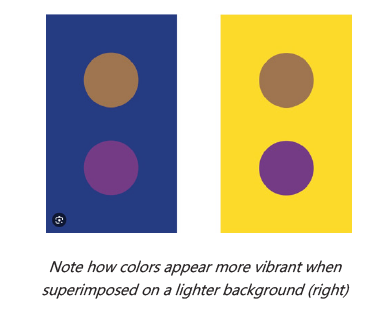
As a general rule, the lighter the cement or background color, the brighter pigment colors will appear. Therefore, cementitious material color can directly impact the amount of pigment needed, and the effectiveness of the pigment.
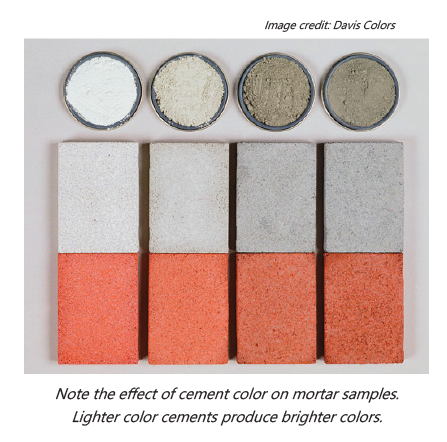
In the graphic above, we see cement colors ranging from white to dark grey in the top row. Unpigmented and red pigmented mortar samples are below. Note how much brighter the white cement samples to the left appear compared with the muddy red color seen in the dark grey cement sample on the right.
This demonstration illustrates why white cement can be a good choice, or sometimes the only choice, for lighter colors like pastels. Interestingly, using white cement will also make blacks more intense.
Cement colors range from white to dark grey. In tests comparing unpigmented and red pigmented mortar samples, the white cement samples appear much brighter compared with the muddy red color seen in the dark grey cement sample.
This demonstration illustrates why white cement can be a good choice, or sometimes the only choice, for lighter colors like pastels. Interestingly, using white cement will also make blacks more intense.
Other cementitious material points to note:
- When replacing cement, fly ash, or slag cement suppliers or materials, always do a color change check using the doughnut method, and make test batches to confirm the impact on color. If you need more information on this simple and inexpensive quality control test, please check with your ACM Technical Service Representative.
- Cement mill certificates should be monitored for changes to Blaine fineness, and retain samples obtained. Finer grind, as indicated by higher Blaine, will produce lighter color cement.
- Different types of cement from the same supplier can have different colors. Type III cements are often made from the same raw mill feed as Type I or Type II, but appear lighter in color because the Type III cement is ground to a finer Blaine.
- Portland Limestone Cement (PLC) is generally lighter in color than traditional portland cement.
- Changing mix designs to increase or decrease the relative proportions or total volume of cement, fly ash, or slag cement can impact color.
In summary, when making changes to cementitious raw material sourcing and or mix designs, be prepared for color to be impacted. Make test batches to confirm appearance performance metrics are met, and prevent unpleasant surprises.
Controlled Curing
Controlled curing in a kiln, or other chamber, is used to accelerate the curing process. Properly managing time, temperature, and relative humidity enables dry cast concrete to hydrate efficiently and consistently.
As we know, temperature affects the rate of hydration. What is not as commonly understood is that the rate of hydration also affects the final shade of cement paste. When units are exposed to inconsistent curing
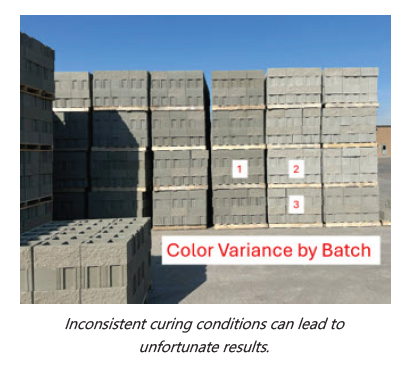
temperatures batch to batch or day to day, we build in potential color variance issues. In one example, three different shades of grey were observed for the same unit. In that case, inconsistent curing cycles were identified as the cause of the variance.
Following the curing guidelines below can improve color performance:
- Where possible, implement a minimum ramp up time of approximately two hours for all colored products before activating the curing system.
- Maintain consistent time, temperature, and relative humidity in the kiln. A common sign of inconsistent humidity levels is lighter colors produced in the upper sections of the curing chamber, and darker colors in the lower sections.
- Measure and monitor kiln performance, from top to bottom and side to side, and take corrective action when needed.
- If temperatures run higher than intended, generally 10 to 15 degrees Fahrenheit (5 to 9 degrees Celsius) above target, lighter product may result.
- If kiln temperatures spike to exceed 120 degrees Fahrenheit (49 degrees Celsius), color fading may result.
- If curing temperatures are too low, concrete may not hydrate and densify properly, which can increase the risk of efflorescence and inconsistent appearance.
- Humidity control is also important. If units dry out too quickly, fading or surface hazing may result. Conversely, if humidity gets too high, for example where condensation or water dripping is observed, water marks or staining on product surfaces can result.
To optimize concrete color performance, maintain consistent time, temperature, and relative humidity in the kiln. Measure and track kiln performance regularly and take corrective action when needed.
ACM Academy
Need more information? Check out free ACM Academy resources, available online at any time, at acmchem.com and on YouTube.

Contact
ACM Chemistries, Inc.
P.O. Box 920430, Norcross, GA 30010
Phone: 770-417-3490
Website: acmchem.com
We hope that the information presented here is helpful. It is based on data considered to be true and accurate, and reflects our best understanding and knowledge, presented for the user's consideration. We do not warrant results of action based on any of the information contained.
Published July 2026.